V2 Multi-Region Architecture
Available on
main— merged in v2.The multi-region topology is opt-in. Single-region deployments (local Kind and single-region AWS) are fully unaffected — no changes to
bootstrap-local.shorbootstrap.share required. To deploy multi-region, use./scripts/bootstrap-multiregion.shinstead ofbootstrap.sh.
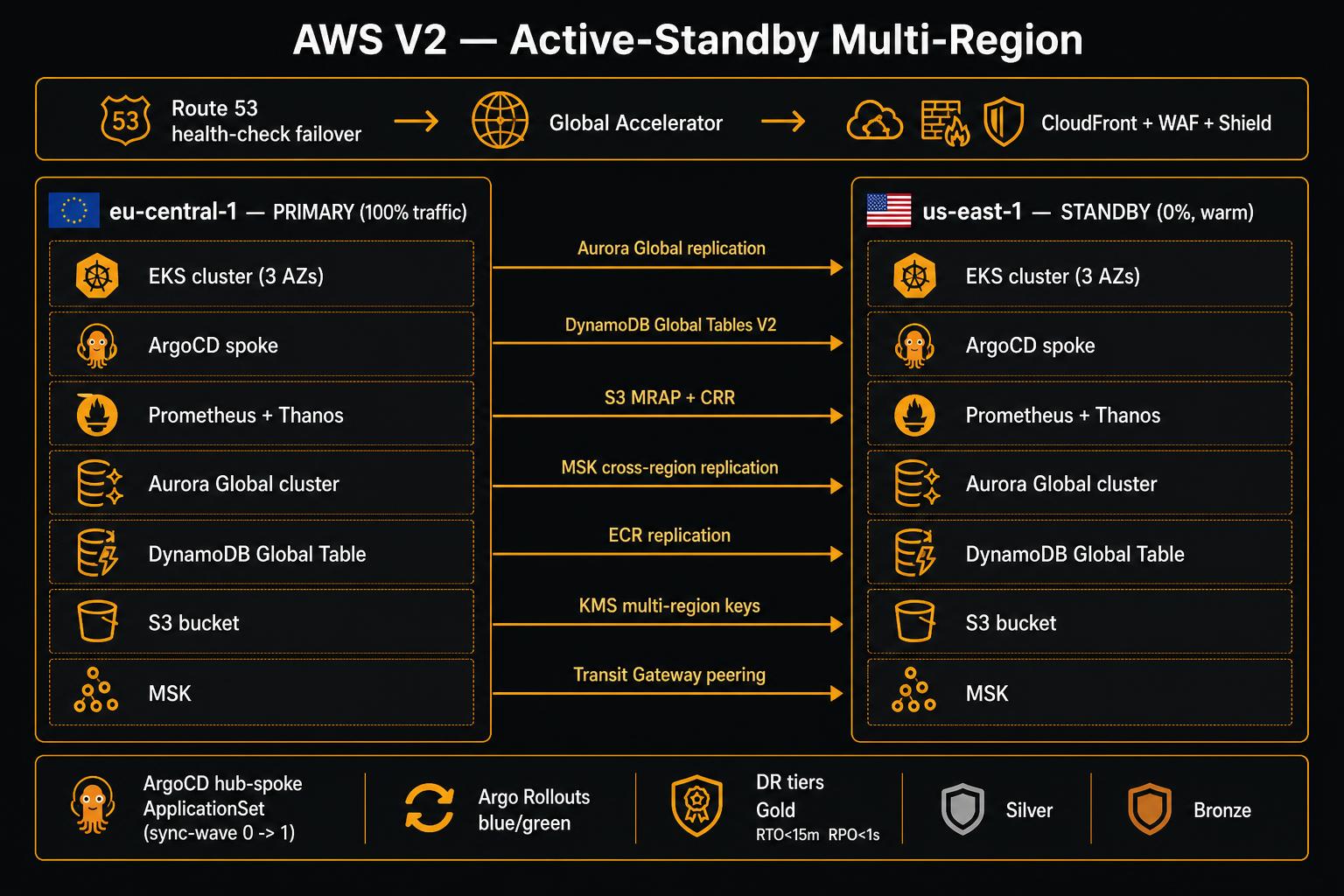
Topology
| Dimension | Value |
|---|---|
| Pattern | Active-standby (not active-active) |
| Primary region | eu-central-1 (Frankfurt) — GDPR-aligned; Aurora writer, ArgoCD hub, Secrets Manager master |
| Standby region | us-east-1 (N. Virginia) — warm standby; Route 53 / Global Accelerator fails over automatically |
| Account model | Single AWS account, multi-region |
| RTO / RPO | RTO < 15 min (Gold tier), RPO < 1 s (Aurora Global) |
1 2 3 4 5 6 7 8 9 10 11 12 13 14 15 16 | |
What's in the Branch
Phase 1 — Foundation
| Component | Path |
|---|---|
| Secondary EKS cluster (us-east-1) | terraform/ applied per-region by scripts/bootstrap-multiregion.sh (--standby-region) |
| Route 53 + Global Accelerator + CloudFront | terraform/global/ |
| ECR cross-region replication | terraform/global/ecr-replication.tf |
| Transit Gateway (inter-VPC, inter-region) | terraform/global/transit-gateway.tf |
| KMS multi-region keys | terraform/global/kms.tf |
| ArgoCD hub-spoke ApplicationSet matrix | aws/argocd/app-of-apps.yaml |
| Secrets Manager CRR + KMS replication | Terraform global module |
Phase 2 — Data Replication
| Component | Details |
|---|---|
| Aurora Global DB | Primary in eu-central-1; replica in us-east-1; global write forwarding (PG 16+) |
| DynamoDB Global Tables V2 | Active-active; PAY_PER_REQUEST; replicaRegions: [us-east-1] |
| S3 CRR + Multi-Region Access Point | Bi-directional replication; single MRAP endpoint |
Phase 3 — Traffic & Resilience
| Component | Details |
|---|---|
| Global Accelerator | Static anycast IPs; endpoint groups per region; health-check-driven failover |
| CloudFront + WAF | Origin failover (primary ALB → standby ALB); Shield Advanced; OWASP managed rules |
| Argo Rollouts | Blue/green per region; CloudWatch/Prometheus analysis gates; sync-wave ordering |
| DR runbook | docs/runbooks/dr-region-failover.md — Aurora promote + ProviderConfig flip + ArgoCD sync |
Phase 4 — Observability & Security
| Component | Details |
|---|---|
| Thanos | Sidecar per Prometheus; S3 object storage for long-term metrics; global Thanos Query |
| Security Hub | Aggregator in eu-central-1 aggregates GuardDuty findings from us-east-1 |
| CloudTrail | Organization trail → S3 CRR → immutable audit logs in both regions |
| Backstage multi-cluster plugin | Both clusters visible in entity Kubernetes tab |
Phase 5 — Platform Wiring
- Platform S3 buckets with CRR for ArgoCD state and Backstage artifacts
- Transit Gateway peering between regional VPCs (non-overlapping CIDRs:
10.0.0.0/16/10.1.0.0/16) - Crossplane
ProviderConfigper region (default→ eu-central-1,us-east-1→ us-east-1) - Failover IRSA roles that can assume cross-region provider configs
Phase 6 — Karpenter + Backstage HA
- Karpenter
EC2NodeClass+NodePoolper cluster (spot + on-demand mix, Graviton preferred) - Backstage warm-standby wiring: Aurora Global read replica in us-east-1 serves read-only during failover
Standby credentials. The standby Backstage reads the same backstage-secrets
Secret as the hub. idp-mvp/backstage is replicated into the standby region by
Terraform (aws_secretsmanager_secret.backstage carries a replica block), and
bootstrap-multiregion.sh applies the SecretStore/ExternalSecret to the standby
cluster with that cluster's region substituted — the primary region's value
would not resolve there.
Order matters and is enforced by the script: namespaces → Backstage
ServiceAccount + IRSA → ExternalSecret (waited on) → Deployment. The standby
Deployment's POSTGRES_* and AUTH_SESSION_SECRET references are deliberately
not optional, so if the secret is missing the pod stays in
CreateContainerConfigError rather than starting up misconfigured and only
revealing the problem during an actual failover. Only the optional integrations
(Datadog, PagerDuty, Jira) are marked optional.
Crossplane XRDs (V2)
New XRDs
| XRD | Claim | Purpose |
|---|---|---|
XECRReplicationRule |
ECRReplicationRule |
Account-level ECR cross-region replication. One claim per account — platform team applies, not service teams. |
XRoute53HealthCheck |
Route53HealthCheck |
Route 53 health check + optional DNS failover record (PRIMARY or SECONDARY). |
XGlobalAcceleratorEndpointGroup |
GlobalAcceleratorEndpointGroup |
GA endpoint group per region. Set trafficDialPercentage: 0 for the warm-standby region. |
All three live in aws/crossplane/compositions/ alongside the existing five.
Example claims: aws/crossplane/compositions/<name>/example-claim.yaml.
Extended XRDs (existing)
| XRD | New V2 fields |
|---|---|
XS3Bucket |
crossRegionReplication, replicaRegion, multiRegionAccessPoint |
XRDSInstance |
globalDatabase, replicaRegion, globalWriteForwarding |
XDynamoTable |
globalTable, replicaRegions[] |
XKafkaTopic |
crossRegionReplication, replicaRegion |
Backstage Templates (V2)
All four live under backstage/catalog/templates/ and are indexed in
backstage/catalog/all-templates.yaml under the Multi-region (V2) section.
| Template | What it creates |
|---|---|
aurora-global-cluster |
Renders Terraform tfvars + opens a PR; platform team applies via terraform/global/ |
dynamodb-global-table |
Crossplane DynamoTable claim with globalTable: true and replicaRegions: [us-east-1] |
s3-multiregion-access-point |
Crossplane S3Bucket claim with crossRegionReplication: true and multiRegionAccessPoint: true |
eks-multi-region |
ArgoCD ApplicationSet (matrix generator) targeting both clusters; sync-wave 0 (eu-central-1) → wave 1 (us-east-1) |
GitOps — ArgoCD Hub-Spoke
Primary ArgoCD in eu-central-1 manages both clusters. The V2 ApplicationSet uses a matrix generator:
1 2 3 4 5 6 7 8 9 10 11 12 13 14 15 16 17 | |
Sync-wave ordering ensures eu-central-1 is always deployed first. Argo Rollouts health gate in the primary region must pass before wave 1 proceeds.
Disaster Recovery Tiers
| Tier | RTO | RPO | Data strategy | Traffic failover |
|---|---|---|---|---|
| Gold (Backstage, platform core) | < 15 min | < 1 s | Aurora Global + DynamoDB Global | Global Accelerator automatic |
| Silver (stateful services) | < 1 hr | < 15 min | S3 CRR + Aurora read replica | Route 53 health-check |
| Bronze (stateless services) | < 4 hr | < 1 hr | S3 backup restore | Manual DNS update |
Opting In
Teams that need multi-region support should:
- Clone or pull
main— multi-region scripts and templates are included. - Use the V2 Backstage templates (available in the Create page — search for "Multi-Region" or "V2").
- Enable V2 fields on existing XRDs (
crossRegionReplication: true,globalTable: true, etc.) in their Crossplane claims. - Apply the three new platform-level claims (
ECRReplicationRule,Route53HealthCheck,GlobalAcceleratorEndpointGroup) via the platform team.
Go-Live Readiness Checklist
The architecture and scaffolding above are built; actually cutting over to multi-region for a
production workload with real (patient) data is a separate, deliberate decision — not something to
flip on as a side effect of a platform update. Use this checklist before running
./scripts/bootstrap-multiregion.sh against a production account:
- Data residency sign-off — Legal has confirmed the cross-region replication path (eu-central-1 → us-east-1) is covered by a valid transfer mechanism for whatever data this deploys with — this is not automatically true just because the infrastructure exists.
- Cost approval — a second full region (EKS, Aurora Global writer/reader, cross-region ECR replication, Transit Gateway, Global Accelerator) is a material recurring cost increase; get sign-off before enabling, not after the first bill.
- DR tier assigned per service — every service that will run multi-region has an explicit Gold/Silver/Bronze tier assignment (see the table above), not just an inherited default. A service handling booking writes should be Gold; a batch reporting job probably shouldn't be.
- Failover runbook rehearsed — the region failover procedure has been run at least once against a non-production environment, by someone other than whoever wrote it, so a real incident isn't the first time it's executed.
- Alerting wired to the standby region — confirm Thanos/Grafana actually alerts on standby-region health (not just primary), otherwise a degraded standby fails silently until the moment you need it.
- Rollback path confirmed — know how to disable multi-region (fail back to single-region) if something goes wrong during cutover, before you need to do it under pressure.
This checklist is intentionally a gate, not a script — running bootstrap-multiregion.sh is a
one-way door for a live production account and should be triggered explicitly by whoever owns that
decision, not automated.
See Also
- crossplane.md — full XRD reference including V2 extensions
- docs/runbooks/dr-region-failover.md — step-by-step region failover procedure
- GitHub Project — multi-region tracked under the Phase 9 "Advanced Platform" milestone